
Contributing
Kaddo is built with its own Knowledge-Driven Development model, and contributions follow the same idea: knowledge and intent come before implementation, and code is reviewed against an explicit Work Item.
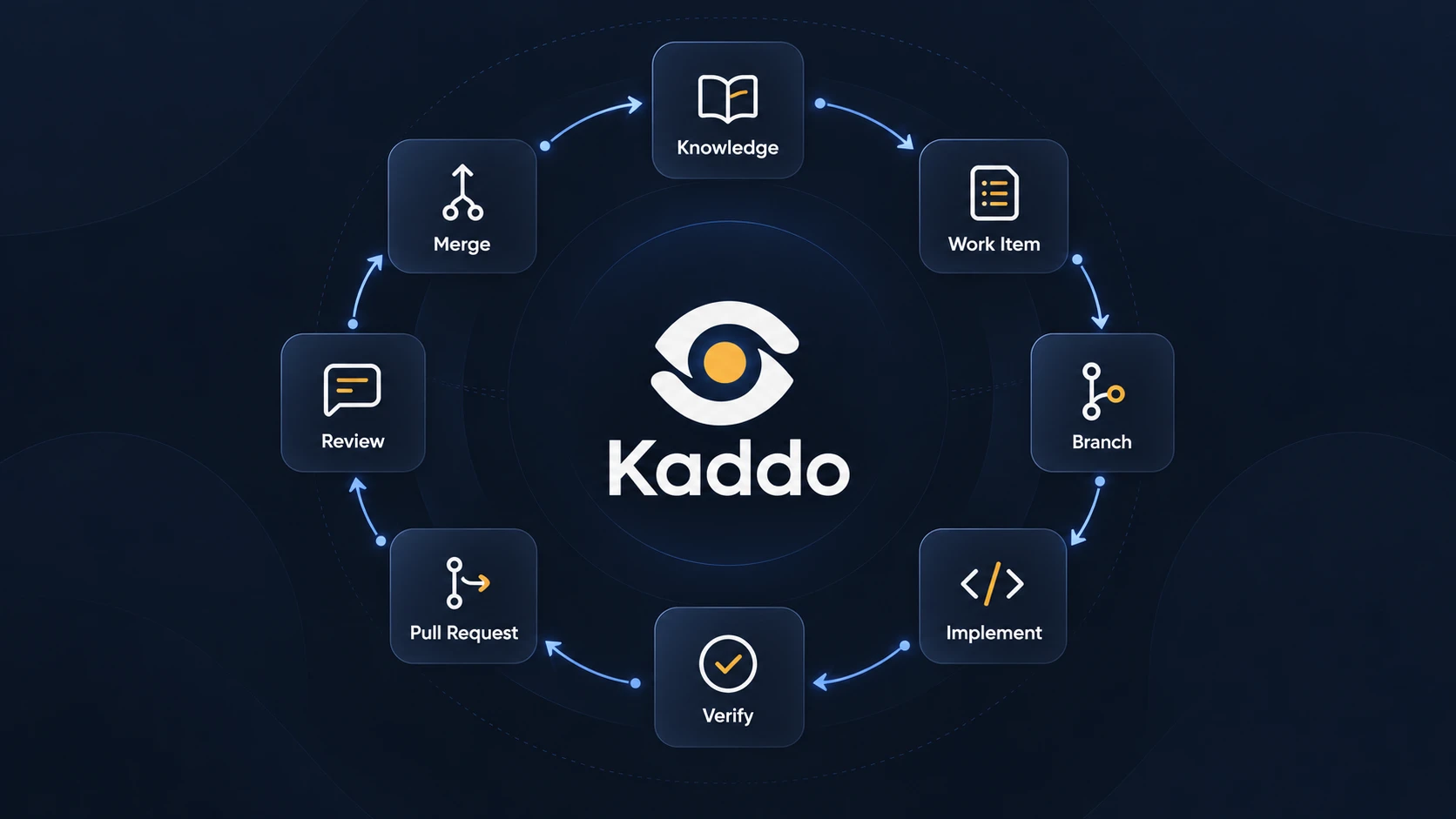
One Work Item → One Branch → One Pull Request.
A contribution should represent a single coherent outcome. This does not mean “small PR” — a K3/K4 Work Item can justify a large PR. It means a PR should not bundle independent outcomes. If work you discover mid-implementation falls outside the current Work Item’s scope, open a separate Work Item, branch and PR instead of growing the contribution silently.
The flow
- Start from the latest
main. - Understand the relevant knowledge first — use Kaddo’s own knowledge (business, product, tech, architecture, capabilities, initiatives, roadmap, completed Work Items and learnings) via the CLI, the MCP server, Kaddo agents, or your preferred LLM. You don’t need to read the whole repo by hand.
- Define or select one Work Item — proportional to the change.
- Planned work: reference an existing canonical
WI-xxx(from an Initiative) — don’t duplicate it. - New / external contributions: include the Work Item definition in the PR instead of
creating a
WI-xxxin your fork. A maintainer decides later whether to materialize it into Kaddo’s canonical traceability. An Initiative is not required.
- Planned work: reference an existing canonical
- Discuss first for changes that need it (new commands/flags, front-matter schema, Knowledge Level or Guard behavior).
- Create one dedicated branch per Work Item (
feat/…,fix/…,docs/…). - Implement, then validate / verify against the acceptance criteria (
kaddo verify <WI-ID>for canonical Work Items). - Open one Pull Request using the PR template — reference the canonical Work Item or embed the definition you used, with validation/evidence and any knowledge impact.
Review is against intent, not just the diff. Reviewers check whether the implementation satisfies the Work Item — intent, scope, acceptance criteria and validation — without undeclared scope.
Full guide
This page is an overview. The complete, canonical contribution guide — setup, project structure, tests, the Build Contract lifecycle, commit style, the Pull Request template and the release process — lives in the repository:
For the lifecycle details behind step 3–7, see the Workflow and Work Item Traceability pages.