What is Knowledge-Driven Development?
Knowledge-Driven Development treats project knowledge as a first-class, observable artifact so humans and AI agents evolve software from the same shared context.
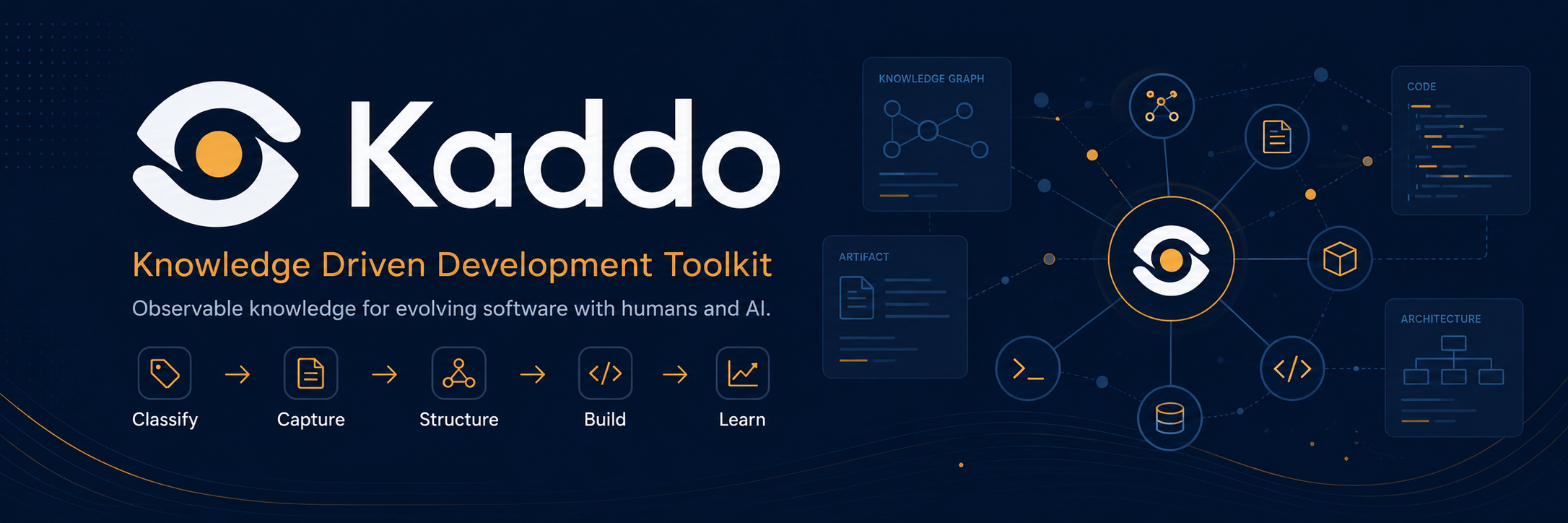
Software teams have always run on knowledge: why a system is shaped the way it is, which constraints are load-bearing, what was tried before and abandoned. The problem is that most of this knowledge lives in people’s heads, in scattered chat threads, or in commit messages nobody reads again. When an AI coding agent joins the work, it inherits none of that — it sees code, not context.
Knowledge-Driven Development (KDD) is a simple reframing: treat project knowledge as a first-class, observable artifact that lives in the repository, next to the code, and have both humans and AI agents work from that same shared context.
Why context is the real bottleneck
A capable coding agent rarely fails because it cannot write code. It fails because it does not know this project: the domain language, the architectural boundaries, the decisions that are not up for debate. Give it the code alone and it will confidently produce changes that are locally correct and globally wrong.
KDD’s answer is not “write more documentation.” It is to capture the knowledge that actually drives decisions — business intent, product capabilities, technical constraints, delivery history — in a structured, versioned form, and to make it observable so you can see when it drifts from reality.
Knowledge as an artifact, not a wiki
The distinction matters. A wiki is prose that rots silently. A KDD knowledge base is structured: it has layers (business, product, tech, delivery), it is versioned with the code, and it can be queried and verified. When a change lands, the knowledge that justified it is right there — and when the knowledge no longer matches the system, that drift is visible rather than hidden.
This is what lets an AI agent contribute like a well-onboarded teammate instead of a fast stranger.
Where Kaddo fits
Kaddo is a toolkit for practicing KDD. It gives you a knowledge base in the repo, a work-item lifecycle that ties intent to delivery, and an MCP server so agents can read the same context you do — without ever treating that context as instructions to execute blindly.
If you want the concepts in depth, read Knowledge-Driven Development. To see it on a real codebase, the legacy project use case walks through adopting KDD on software whose knowledge only lived in people’s heads. When you are ready to try it, start with Getting started.
The goal is not to replace developers with agents. It is to make sure that whoever is working — human or AI — is building from what the team actually knows.